A phased approach to rapid commercial production — 18 months from financing to first output
The historical project plan, as defined in the 2011 Feasibility Study, called for an investment of $620M USD in a Hydromet facility at the mine site. This plan was fundamentally non economic and coupled with low resource prices led to the failure of Geocam.
ARM has developed a fundamentally different approach: focus on rapid production within 18 months of new financing.
ARM's plan centers on a new metallurgical process using Dense Media Separation (DMS) to produce a mixed Ni-Co concentrate. The plant uses magnetic separation to further refine the ore, improving efficiency while dramatically reducing upfront capital requirements.
The DMS facility is designed by Consulmet, a world leader in dense media separation technology. This approach streamlines operations, reduces costs, and boosts recovery of high-value minerals.
The processing facility will be located at the mine site, resulting in a significant reduction of transportation costs by producing an easily exportable concentrate at a sought-after grade, rather than exporting low-grade DSO (Direct Shipping Ore).
The process involves crushing, scrubbing, sorting, magnetic separation, and dense medium separation (DMS). This pre-concentration technique removes gangue minerals by leveraging the difference in specific gravities between valuable and waste materials.
The on-site facility approach means that only high-value concentrate is transported to the Kribi seaport, dramatically improving project economics and reducing the environmental footprint of logistics operations.
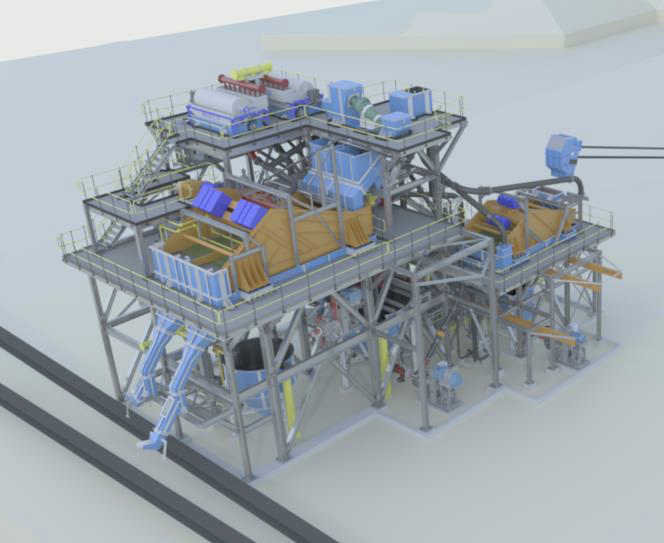
3D rendering of the 120 TPH DMS Module
International earth and water resources consultancy providing exploration, engineering, and environmental consulting. SRK prepared the full NI 43-101 for Nkamouna including a review of the Lycopodium feasibility study.
Process engineering group focused on mineralogy-driven solutions. Hired to design and construct the Dense Media Separation facility on site — a pre-concentration technique that streamlines operations and boosts recovery of high-value minerals.
South Africa-based economic solutions consultancy. Developing an updated feasibility study with a comprehensive financial model based on current assumptions and performing sensitivity analysis on key project variables.
The project is road-connected to the Kribi deepwater seaport (~400 km). New transportation routes have been identified for efficient trucking management to and from the project site.
The planned new railroad for the Mbalam iron ore project runs within 60 km of Nkamouna (estimated completion 2030), providing potential future rail access for concentrate export.
By processing ore to concentrate on-site, only high-grade material is transported — dramatically reducing logistics costs and environmental impact versus DSO export.
ARM's phased development plan is designed for speed, capital efficiency, and scalability — with 18 months to first production.
Contact ARM